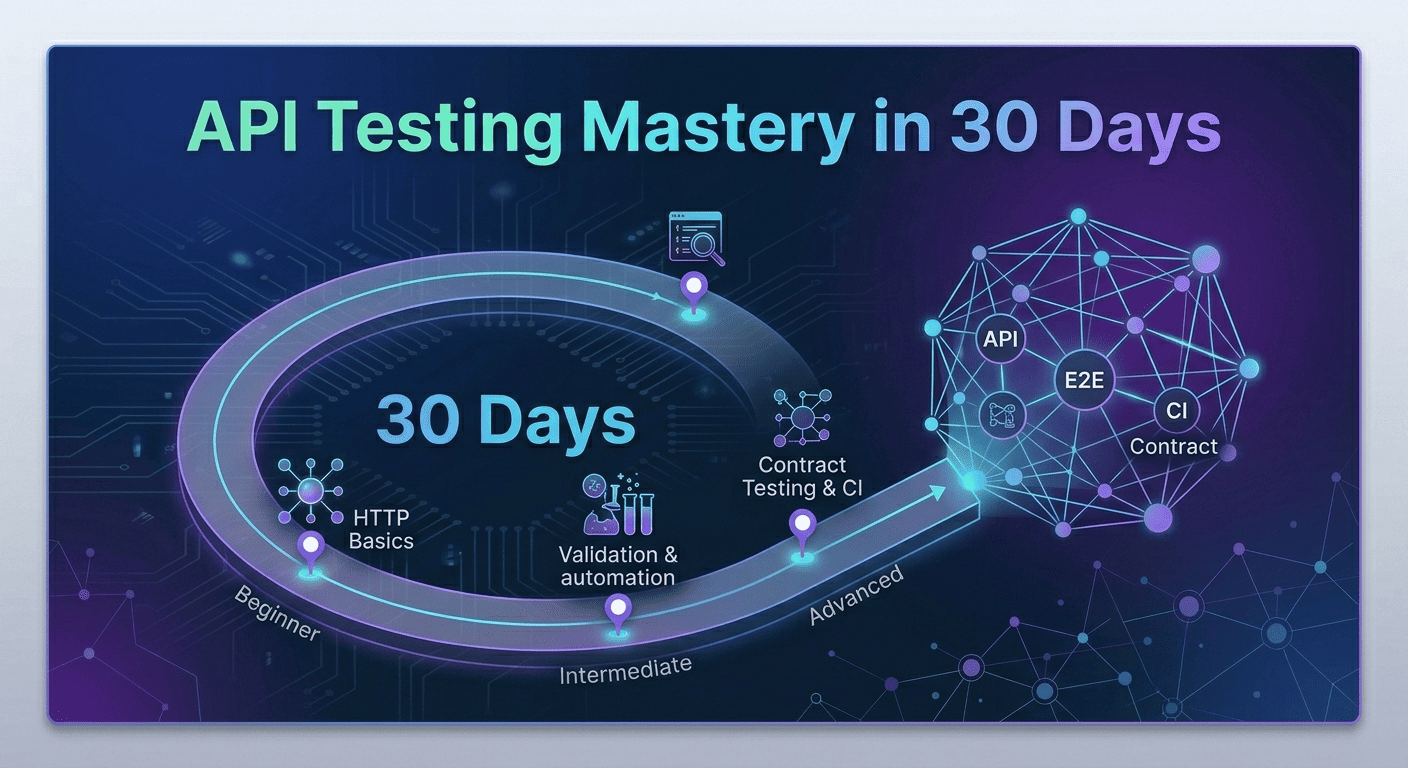
APIs are the backbone of modern software, but API testing is still one of the most under-invested areas of QA. This 30-day plan turns that around. By the end of it you'll know how to design, run, and automate meaningful API tests that catch bugs early — where they're cheapest to fix.
Who This Is For
- QA engineers and SDETs who want API testing to be more than "poke Postman and hope."
- Teams building or consuming microservices that need trustworthy contract checks.
- Developers doing their own testing who want a structured way to cover the API layer.
Why API Testing Matters
Bugs caught at the API layer are dramatically cheaper to fix than bugs surfaced via the UI. The API is where business logic lives — if it's wrong there, every screen that depends on it will be wrong too. Investing in API testing shifts quality left without slowing the team down, and it's typically more stable than UI automation.
Week 1 — HTTP & REST Foundations
- HTTP methods, status codes, and the anatomy of a request/response.
- Headers, idempotency, caching — the protocol essentials that trip most testers up.
- Setting up curl and Postman, and actually learning their workflows (not just copy-paste).
- Building your first Postman collection for an app you know.
The goal for week one is fluency. By day seven you should be able to read a request and predict the response, and tell from a status code alone whether the server is being nice to you.
Week 2 — Validation & Testing Strategies
- JSON structure and schema validation — writing a schema for your API and enforcing it.
- Happy-path vs negative test case design: what does your API do when given nonsense?
- Data types, pagination, and edge cases: empty arrays, huge arrays, Unicode, null.
- Assertion patterns that stay readable as the suite grows.
This is where most teams stall. They verify the happy path and stop. A real suite covers the boundary conditions and the ugly inputs too — that's where the production surprises actually live.
Week 3 — Security & Advanced Automation
- API keys, OAuth 2.0, and JWT authentication flows — in depth, not just "attach a token."
- Choosing an automation framework and architecting the suite (Postman Newman, Playwright, RestAssured, or pytest-based stacks).
- Environment variables, secrets management, and reliable test-data strategies.
- Mocking and stubbing when third-party APIs are in the way.
Week 4 — Enterprise Integration & Quality
- Contract testing between microservices — catching breaking changes before they hit prod.
- Wiring tests into CI/CD and mitigating flakiness with deterministic design.
- Allure or Extent reports and metrics dashboards that non-testers actually look at.
- Handling third-party dependencies and rate limits gracefully.
What You'll Have After 30 Days
- A working API test suite tied into CI, with deterministic and idempotent tests.
- Schemas, collections, and code checked into source control.
- A mental model for where API tests fit on the test pyramid alongside unit and E2E.
- Reports that tell the story, not just a pass/fail count.
Ready to Go Faster?
Pair this roadmap with TestCaseMate to auto-generate test scenarios from your API specs, and TestCase Reviewer Buddy to catch coverage gaps.