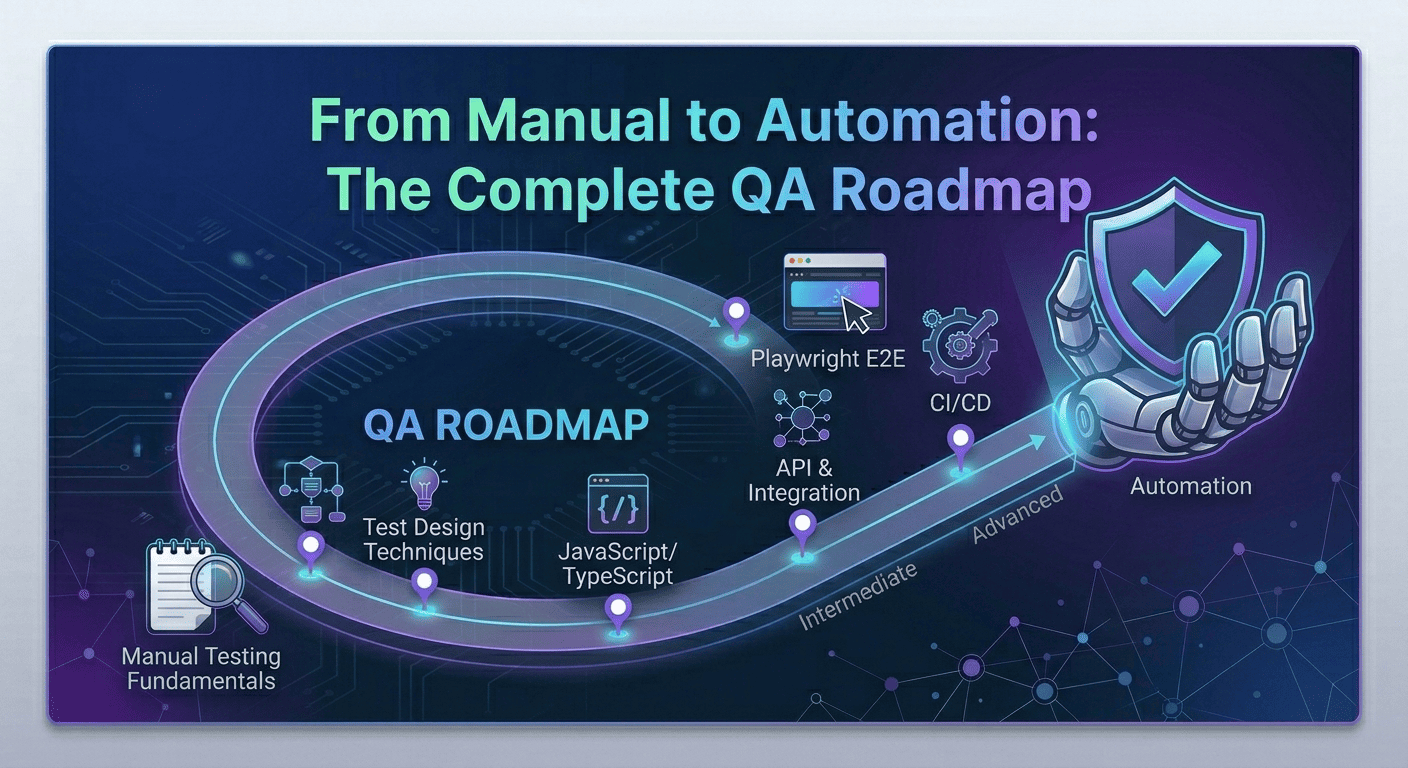
Testing isn't just about finding bugs — it's about building trust in the software you ship. Whether you're starting from scratch or a manual tester ready to move into automation, the roadmap below is the one we wish we'd had earlier in our own careers. It takes you from fundamentals all the way to owning a modern, automated QA practice.
Who It's For
- Newly hired QA engineers who need a clear first-year plan.
- Manual testers ready to move into automation without getting lost in tutorials.
- SDETs who want to systematise and strengthen the skills they already use.
- Team leads standardising how their QA group levels up.
What You'll Learn
The roadmap intentionally mixes theory with hands-on practice. You'll build a working knowledge of:
- SDLC and STLC fundamentals — Agile/Scrum roles, where QA fits, and the testing hierarchy.
- Test design techniques — boundary-value analysis, equivalence partitioning, decision tables, and the bug lifecycle.
- Tooling — JIRA for tracking, TestRail or TestLink for case management, and reporting stakeholders actually read.
- Programming for testers — JavaScript / TypeScript essentials, async/await, and the modern ES features you need for Playwright.
- Automation architecture — the Page Object Model, data-driven tests, fixtures, and parallelism.
- Beyond functional — performance and security perspectives, quality metrics, and compliance readiness.
- Integrated flows — combining API and UI automation and running everything through CI/CD.
How the Roadmap Is Structured
The roadmap splits into three tracks so you always know what to focus on next.
Beginner
Foundations first: testing principles, documentation habits, design techniques, and a gentle introduction to automation. You'll leave this phase able to write clear test cases, log meaningful bugs, and execute your first scripted tests.
Intermediate
Architecture starts mattering. You'll move from ad-hoc scripts to a Page Object Model layout, add data-driven coverage, blend API and UI checks, and set up reporting that gives everyone a single source of truth.
Advanced
Quality as a system. Performance and security enter the mix, risk-based planning replaces brute-force coverage, and dashboards communicate real signal to the rest of the organisation. Compliance maturity follows naturally.
Key Highlights
- Judgment, not dogma. You'll learn when manual testing is still the better investment — automation isn't always the answer.
- Real workflows. Design techniques applied to workflows you actually encounter in product teams.
- Playwright in depth. Locators, waits, assertions, and the debugging tools that turn flaky suites into trustworthy ones.
- Quality as a system. KPI-driven dashboards and decisions, not gut-feel "ship it" calls.
How To Use This Roadmap
Learning that sticks is active and daily. Don't just read — produce artefacts. Every week, ship something concrete:
- Write a test plan or test case set for a feature you're using right now.
- Refactor one piece of existing work to match the new pattern you just learned.
- Track a weekly outcome — flakiness rate, a mini dashboard, a reduced run time.
Build muscle memory by revisiting the architecture patterns often. The second time you implement POM it clicks; the fifth time you can see the trade-offs clearly.
Ready to Start Your QA Journey?
Jump into QA-Mastery-Hub to follow the interactive version of this roadmap with AI-driven learning recommendations tailored to where you are today.
Outcome
By the end you'll be able to design, automate, and own reliable QA processes; deliver high-signal coverage backed by actionable metrics; and apply risk-aware prioritisation across product initiatives. In short: you'll be the QA engineer teams actually want to hire and keep.